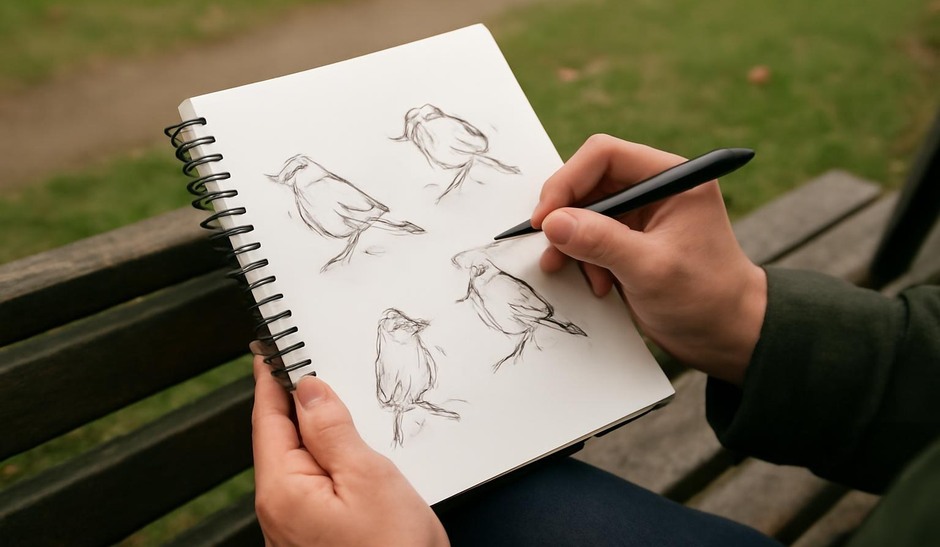
Sketching Moving Subjects: Birds, Insects, and Quick Gestures
Why gesture matters
When subjects move, the aim is not to copy every feather or leg but to capture posture, proportion, and motion. Gesture drawing trains you to record the most telling lines quickly. Over time these studies build visual shorthand you can use for more detailed work later.
Tools and settings
Use a medium that allows rapid marks: a soft pencil, charcoal stick, or a broad-tipped pen. Sit where you can observe without causing disturbance. If possible, bring a friend to act as a timer so you can focus purely on drawing.
Timing drills
- 30-second gestures: Sketch the subject as soon as you see it. Make one continuous line for the main action. Don’t lift the tool often.
- 2-minute studies: Add a few structural lines: head position, spine, limb placement. Keep marks economical.
- 5–10 minutes: Choose a stable pose to develop a quick tone or indicate texture. Use this time when the subject rests.
A simple observational checklist
- Silhouette: note the overall shape first.
- Axis line: indicate the spine or flight line.
- Primary mass: head, body, or thorax placement.
- Force lines: directions of motion or weight.
- One texture note: small strokes for feather direction or wing membrane.
Common beginner traps and calm corrections
Beginners often try to fix proportions with erasing, which wastes time. Instead, build a light, confident first pass: a loose oval for the body and a line for the axis. If proportions feel wrong, add a single corrective line rather than erasing and redrawing.
Practice plan for a weekly session
- Warm-up: 10 one-minute contour drawings of static objects.
- Field gestures: 10 thirty-second sketches of moving subjects.
- Two longer studies: one 2-minute and one 8-minute sketch when the subject is stationary.
- Finish with a short note: what motion quality did you notice (jerky, gliding, frenetic)?
Reflection prompts
- Which gesture captured the subject’s character best and why?
- What recurring mistake did I make with proportion or axis?
- How did timing affect the marks I chose?
- What small adjustment would help my next session (different tool, angle, or timing)?
Working with moving subjects trains both speed and visual prioritisation. The exercises above keep practice focused and light. Over time, gesture drawing becomes a way to retain the essence of a scene, even when details are fleeting.